This post has me back on Broadturn for two more weeks. It has been over a month since I was last here. These would be my last official work exchange days on Broadturn.
My initial thoughts at 5am while pulling in were thoughts of awe. This did not look like the same farm. Everything had grown so much in a month. Flowers that were just seedlings were 3 feet tall and full of blooms. The fields were filled with color, greenery and life. An awful lot happened in a month here.
I spent the mornings harvesting lettuces, collards, beans, basil, kohlrabi, arugula, cabbages, broccoli, garlic and pac choy, just to name a few. Broadturn is a cornucopia of diversity every week when it comes to harvesting. It's exciting. I can imagine for a CSA member, driving up to the farm is an experience filled with joy, wonder, amazement. "What are we going to pick up this week? What are we going to do with it when we get it home?" The possibilities are endless.
I noticed so many different things on my second visit to Broadturn. There were a bunch of new rows of plantings where old vegetables had been harvested and tilled under. I asked John about this. He said that he works off a spreadsheet, starting with a projected CSA pick up date for a particular vegetable then working backwards to determine when it should be planted so that it matures on or around the right time. Many things get second or even third plantings.
This opened up an awareness to me. The Maine growing season is longer than I thought. I was working under the assumption, 'plant the garden, maintain the garden, harvest the garden'. I had not figured the 're-plant the garden' into the equation. It really makes perfect sense, and I feel a little silly for not picking up on this before. If something matures to harvest size in 30-60 days from planting, that really does give time for second or even third harvests of certain things.
So, applying this new found knowledge to my own life, I did a little research and figured out I could fill a few holes left in my garden from harvested peas, lettuce, onions and potatoes with kale, collards, spinach, peas, and salad greens. It was really exciting to plant new things. It gives me something to look forward to over the the next few months.
People get sad when things are out of season. When the strawberries and peas are gone, people notice. I'm the same way. Harvest is wonderful, but knowing you don't have that particular fresh fruit or veggie to look forward to until next season is a bummer. With successive plantings, the season is extended as long as it possibly can, thus keeping the bummer at bay until frost sets in. So, while we may have to say goodbye to the Spring peas, we can say hello to Fall spinach.
Now that we are past the half way mark in our work exchange, I am thinking of the future. It was hard to drive away from Broadturn on my last exchange day there. I feel connected tot he place, to the people, to the crops. I know I'll go back and visit, just to see how things are. The artistic team had a retreat last weekend. We spoke about what we have accomplished so far, the challenges we have overcome and the challenges we will face as we mount the next phase of the project. But we are up to it. Where I may have to say goodbye to some farms, people, plants and animals. . . I am psyched to say hello to a wonderful, creative and exciting future of theater.
Monday, July 26, 2010
Saturday, July 24, 2010
OK, Corral and What Not To Do (Jennie)
I don’t think of myself as a terribly large person. If you bother to do the math, my body weight accounts for approximately 7% of an average Holstein dairy cow. And yet thrice now I have been instructed by Ryan to “stand over there” with my arms spread to full span, and to “keep the cows from going that way”. Really? Me? Are you sure? There’s not a half note of hesitation in his voice. “Don’t be afraid to hit her”. Oh, well, okay. In that case . . .
It is 11 am on a Wednesday, and Ryan and Tristan are out to catch a troublesome heifer. Two weeks ago, I stood with Cory and Claire in the Bensons’ kitchen and watched through the window as three people attempted to coax a stubborn cow across the road. It took them more than 20 minutes and no small amount of physical persuasion. And that very heifer is the one we have to catch today. Right now.
We let ourselves into the dry cow pasture and Ryan identifies our target. He places me next to a dried cow pie and heads off toward the heifer in a far corner of the pasture. She immediately begins moving away from him, zig-zagging back and forth through the grass. “She knows something’s up”, says Tristan. “If she jumps the fence . . .” says Ryan, trailing off as the heifer leaps the electric boundary and bounds off through the compost piles. “Like that?” asks Tristan.
Now I have a new job. When the heifer jumped the fence, she took a good forty feet of it down with her. So my new job is to defend the weak corner of the fence and to keep the remaining 25 pregnant cows inside the pasture. Sure. No problem. I am huge, intimidating, in control. My heart is racing. I’ve got this.
Ryan and Tristan sprint up into the compost heaps in search of the loose heifer, calling each other as if playing some complex, high-stakes game of Marco Polo. I can only occasionally see them as they round a corner before heading down into a swamp or racing up the drive. The cow appears every now and then as well, never within reach of her pursuers. I anxiously await the conclusion of this episode and regard my charges with what I hope is pronounced disinterest. Ryan assured me that these cows wouldn’t give me “any trouble”. They don’t know the fence is down, after all.
Within two minutes of Ryan’s departure, I nervously acknowledge the approach of a large, mostly black cow whose name I do not know. She makes her way toward me slowly, but with determination. I’m pretty sure she’d like to know what I’m guarding. Otherwise, she hopes to follow her former companion across the breach. Either way, she must be stopped.

“Go on”, I tell her. Really, it’s almost a whisper. “Go on, get out.” She continues toward me, moves as if to pass me on the right. I step in her way. She tries a fake to the left. I block her again. She plants herself inches from my shoulder, sniffs at my arm, cranes her neck to see behind me. I stand very still and try not to piss her off. I know it’s silly, but standing there with a 1200 lb cow staring me in the face, I half expect to be charged. I find it difficult to look her in the eye. I remind myself repeatedly that she is not a bull. I endure her presence for an eternity, finally swat her on the rump and bark at her. She saunters off. Thank heaven.
Ten minutes later, she’s back. This time, she’s brought some friends. I move into the tall grasses just feet from the most vulnerable section of fence and find myself surrounded by no less than five cows. Oh, man I wish those guys would catch that damned heifer. How long can I carry off this farce? How long before one of these ladies decides to ignore me? What then? 26 cows loose in the compost. My fault.
One of the new cows advances. I suck in my breath and prepare for who knows what. She thrusts her nose toward me. I slap her on the jowl. She pushes her nose at me again. I tell her to be gone. The third time, I scratch her between the eyes. I stroke the bridge of her nose and I realize that the other cows are looking kind of jealous. Maybe all they wanted was to say “hi”?
With great relief, I see Tristan headed toward me through the grass. The loose heifer has, inexplicably, returned to the pasture. Ryan and Tristan have given up for now; they fix the fence and leave the heifer until after lunch. Holy wow, holy cow, it’s over. I did it. Somehow, my substantial body mass was enough to block five cows.
****One week later; we are once again chasing a heifer. By this time, I’ve participated in blocking, guiding, and redirecting cows on multiple occasions. I’ve even led a cow to pasture by myself. On this day, I am ecstatic to find that I am no longer afraid. I’m actually kind of excited. It’s exciting stuff, chasing and catching cows.
The heifer we are meant to catch this time is destined for a sale in Turner. The truck that will transport her to this sale is currently sitting in front of the milk barn. The man who drives the truck is waiting. Everyone feels some pressure to make this a quick and clean transaction. Catch the cow. Put the cow on the truck. Wave bye-bye.
By the time I reach the pasture, Ryan and Tristan are already running alongside a largely white heifer in a nearby corner. There’s no one there to tell me where to stand, so I make my best guess and plant myself in “athletic stance”. Within a few moments the cow, and Ryan, come bolting toward me at full speed. I throw myself into the game and run too – trying to contain the cow within Ryan’s reach. She sprints forward and beyond us and is over the nearest knoll in seconds.
“Jennie,” says Ryan, “come up here – we want her to go toward the fence.”
Minutes later we are again chasing the cow over the knoll and back toward the pasture gate. And once again, I manage to put myself in the wrong place. The wrong place? That would be between the cow and the fence. Thanks to Claire, we have excellent documentation of this.
So here’s me – very enthusiastically doing exactly the wrong thing:

Among other things I’ve gotten confused, or just plain wrong, in the past two weeks . . . I have these additions to make to our glossary:
The 3 Scrapes
- Scrape Back: To scrape cow feces and urine off of their beds and into the grates behind them. Also involves scraping piles of poo through the grates and covering wet spots on the floor or bed with sawdust.
- Scrape Down: To scrape the last of the old feed (silage, hay, and /or grain) away from the cows to the end of the barn. “Scrapings” are piled in front of the last three stalls on each side of the barn. The cows in these stalls are in the process of being “dried off” and will soon go to pasture. They are nearing the end of their pregnancies, and the extra feed will limit their milk production.
- Scrape In: To scrape the morning’s feed toward the cow. This is generally done before “graining” and allows the feed to stay within each cow’s reach (they’ve generally spread it around and pushed it out of reach by mid-morning).

Wednesday, July 21, 2010
The Group Psychology of Summer Squash (Cory)
"How long until these tomatoes are ripe?"
Hands still occupied by the hose attachment she's using to feed the green tomatoes, Penny tosses her long-cut bangs back on her short-cut hair, surveys the greenhouse, and considers. I've been shadowing Penny since 7am. It's now nearly 4pm, and this half hour of tomato feeding, just the two of us (and the plants) in the greenhouse, is the first moment I've seen of anything that I might ordinarily call "calm" in her busy day.

We can see the farm stand just down the hill -- Trae in her bright orange smock slinging vegetables from sink to sink with her headphones clamped over her ears, probably blasting Vivaldi; Joy washing summer squash, testing for rotten ends and funny shapes; The Guys unloading a truck bed of green beans and flat beans fresh from the field. For once, though, Penny's focus is away from the havoc of her hundred farm stand, wholesale, farm bus, harvesting, planting, watering, weeding, labeling, and emailing duties. She even rejects a phone call on her constantly ringing cell. For once, Penny is doing just one thing: feeding the tomatoes.
Well, two things. Feeding tomatoes and talking to me.
"You know, I really can't say," she answers. "Tomatoes are funny plants. One can go red, and you think they're all about to get ripe, but then the rest can stay green for a week. It's like summer squash and zucchini. You'll see a bunch of them that are this big, not quite big enough to harvest but almost there, and then they'll just sit like that. For weeks. You'll keep seeing more and more of them at that same size but the ones that got there first don't get any bigger. As if they're waiting for their little brothers and sisters to catch up. You know, Bib and I have this theory? That they know when we want their fruit. They'll sit at the same size forever, and then we'll finally pick the first one and all of a sudden pop, pop, pop, they're all ready."
We are just passing the midpoint of this summer's work exchange and nearing the home stretch. The end of the summer is on the OFAF team members' minds, and we ask ourselves and each other different iterations of the same questions at our meetings: Are we getting all of the information we need to write a play? Are our relationships with the farmers and farm workers in the right place at the moment? On August 20, will those relationships be where they need to be for this thing to work?
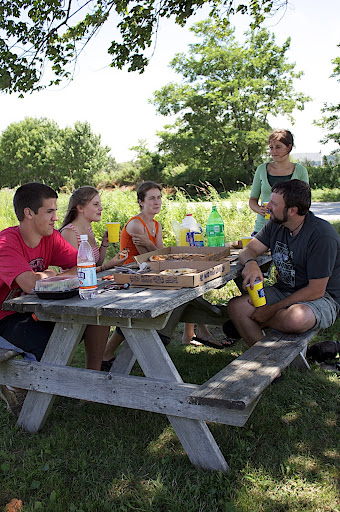
Ben and Joy chat with Jennie, me, and Keith at
Jordan's -- pizza is great relationship fertilizer.
Jordan's -- pizza is great relationship fertilizer.
Writing a play is not chemistry, where two milliliters of X and a half liter of Y gives you Z every time; writing a play is not mathematics, where the square root of 9 doesn't change based on the weather. Writing a play is biology. Writing a play is growing things. Writing a play is a leap of faith. Writing a play is farming.
Last growing season was a season of rainfall, of struggling to keep up. This season -- so far -- our farmers all seem to be on schedule...even ahead of schedule. Eddie and Ryan on Kay-Ben reiterated at last week's story circle how bizarre it feels to be so on time with everything this year. At Jordan's today and yesterday, I heard talk of everything being early so far. The produce in the farm stand's unusually plentiful and varied. I don't know nearly enough about ordinary growing seasons to judge for myself, of course, but one thing is for sure: every season is a different game. No plan is foolproof on a farm. No tomato is immune to late blight, no hay is safe from a freak thunderstorm, no cow is healthy her whole life, no field stays weeded, no rain is guaranteed to fall. There are always fires, broken fences, late or early frosts, and family emergencies. You plan for what you can, and you deal with the rest when it happens. And it happens, and it is never the same ballgame.
When I get ready to write a play, I do my best to make sure all my ducks are in a row. I do research and I talk to people and I spend time thinking and I journal and I consider possible characters and possible plot lines and all sorts of crazy ideas go through my head. And one of those ideas is the seed from which the play will grow. But every play grows differently from the last. Some seeds need more care than others, some fall victim to doubt or indecision or self-censorship, some pop up too early and are forgotten by the time the time's ripe, some get all tangled up in weeds of too-much-complexity and overly-ambitious-concepts, and some are beautiful but fragile and can't take root.
Some grow faster than in your wildest dreams. But that is as rare as a perfect growing season.
Last week we all took some time together to take stock of where we are. It gave me the opportunity to look back over the preceding seven weeks and recognize that, yes, we already have a lot of material and there are countless potential plays beginning to germinate in that playwright greenhouse. But there is still a lot of work to do before we can even narrow things down to one potential play -- which is what the rest of this summer's about; and then even more to do to help that play grow. And I'm looking forward to that feeling I get when all the research and all the prep work is done and there is really nothing to do other than wait for our ideas to start to ripen into a play...and hope that everything we've done to prepare for the harvest will be enough this time.
The ideas ripen bit by little bit, waiting for one another, stalling, waiting for that first one to finally swell up big and ready, and then pop, pop, pop -- there they all are.
New Farm Term:
Seconds. Not what you fill your plate with after you've already had one helping at dinner. This is the word for fruits and veggies that are "not perfect, but still tasty" (in the words of a Jordan's Farm Stand sign). Slightly overripe or misshapen summer squash, bumpy cucumbers, funny-looking apples -- whatever the a-bit-the-worse-for-wear produce, farm stands will often sell it at a discounted price.
Friday, July 9, 2010
Beauty Of The Day (Jennie)
Tuesday morning and the bees are busy at Broadturn Farm. My first day of work at Broadturn is a CSA pick-up day, and therefore a harvest day. Therefore, there are many hands at work in the fields, rapidly harvesting the last of the season’s strawberries, a few trays of peas, some chives for the “herb bouquets”. The entire farm is engaged in one great push to beat the clock, to place the bounty on the table in time for that first customer's inevitably early arrival.
In contrast, when I roll in at 5:10 am on Wednesday morning, there is a pronounced hush on the farm. Nighttime lingers still, as evidenced by Stella, the Great Pyranees guard dog, who has spread her great bulk across the width of the driveway as I pull in. It is the end of her shift. She rolls out of my way, sniffs my hand in tentative greeting, and bounds barking madly into the woods as I set out in search of Stacy.
We are preparing to plant. I am thrilled. In all of my farm visits thus far, I have never had the chance to plant. I have been feeling this gap in my understanding of The Process . . . what if I never get to plant? Never say never. Stacy hands me a glove and a bucket of fertilizer and climbs atop a freshly plowed bed with the furrower (says Sam: nice furrows! Hey Baby, I like your furrows.) I follow behind with my bucket, scattering a little extra love into the neat grooves. It is early; we work quietly. Sam begins pulling trays of cabbage and dill seedlings out of the truck. She makes her way down the rows, carefully placing each plant atop my fertilizer in eighteen inch increments. Courtney follows Sam, standing the plants upright, mounding the earth around them. We make our way through the morning this way, each person preparing the way for the next. I love the feeling that this motion I am repeatedly making, swinging my right arm to release a handful of dust, is one part of a necessary chain of events. I love being part of this process, of carefully preparing the soil to support life.
Once the beds have been prepared I jump in with Courtney, nesting seedlings into the earth. The rows are long but I don’t seek the end. I find myself wondering – what must this transition be like for them? To go from crowded trays in the warm moist greenhouse out to the open, to live under the vast sky (and on this farm, the sky is vast). To leave a world of scheduled waterings and find oneself reliant on unpredictable weather? Would it be like leaving kindergarten to attend college? Graduating junior high to start your first job in the “real world”? I want to make it smooth for them, this challenging time of change. Cover them just right, place every blessing in their path. For awhile, I whisper to each plant as I move on to the next: “good luck”.
We are four women. Moving slowly in straw hats through the rows. I am new at this work, but when Flora comes out to join us I feel as though I am a part of some timeless chain of knowledge. I listen as she follows Sam and joins in the labor; I can feel her concentration as she places each plant exactly as directed. (“This is a baby one,” she says. “A little baby one.”) We are all synchronized in some elemental understanding, some kind of female approach. Our work is harmonious: with each other, with the earth . . . and here is the next generation – observing, playing, learning.
“Well that was a good hustle,” says Stacy, just before our break for tea. “A good morning's work.” Mmm. Indeed.
I make my way across the field to the house, pulling a cart behind me. The breeze pulls my hat across my face. I can smell salt in the air, see the pines towering over our province. I am overcome by the beauty I have experienced this blessed day (the purple of the kohlrabi!). Overcome by the beauty of the day . . . and it is only ten o'clock.

Friday, July 9. It has been nine days since I pressed cabbage seedlings into fresh new beds and wished them luck. It has been nine days, and in those nine days our region has witnessed a string of record high temperatures. In nine days, there has been no rain.
I hop aboard the tailgate of John's truck with two CSA members at 8:15 in the morning; we are making our way across the road to harvest that beautiful purple kohlrabi. As we tread down the rows toward the kohlrabi, we pass the beds of cabbage and cilantro that I helped to plant. I am in the process of absorbing their flatness, their wilted pale yellow leaves fixed to the hard, dry dirt, when John indicates the plants and blithely states: "casualty of the drought". No! Casualty? But it's so final! Is there no hope? I press for more information. John says that he and Stacy watered the new crop by hand over the weekend. They had hoses running from his tractor (I can only vaguely picture this). The brussel sprouts, the cilantro, the chard - they are doing okay. But the cabbage? "Well," he doubtfully shrugs. "It's supposed to rain tomorrow. Maybe they'll come back."
And so it is a day for reflecting on the end of things, for travel to the other side of the great cycle of life. Here on the farms, one seems to get fairly cozy with the myriad expressions of that cycle, even when you only work for a day and a half each week. After harvesting kohlrabi, we moved on to the very last of the season's peas. Peas are my personal favorite of Maine's summer treasures, and it seems impossible that we must bid them goodbye again - until next year! It has been such a very short few weeks! And then the strawberries . . . we picked through the fields one last time this morning . . . it was "the last hurrah" as Stacy said. But just four weeks ago I was struggling to keep up with the strawberry harvest craze at Jordan's! How can this be? Today the berries were small, heavily enjoyed by bugs, hard to locate - it was slow going. It felt for awhile like a bad day on the 405, that notorious traffic-logged freeway of the Southland that once claimed too many of my waking hours. I looked to the left, to the right, and I could swear that traffic was moving faster everywhere but here. Over there, the berries are red, ripe, and plentiful - I can see them. Maybe I should just jump into that row? Or is it a mirage of the heat?
And so we bid these crops goodbye. For another year. Sam scrambles this afternoon to pick pick pick for her weekend strawberry jam, because tomorrow morning the entirety of the strawberry crop will be mowed flat. That's it. It's time. Time to pick up, time to move on to the next "crowd pleaser".
Glamor Shots (Claire)
Do you remember Glamor Shots? They loom large in the category of my memories reserved for
things that made me really jealous in grade school. Really lucky girls from my class would go to
the Maine Mall for their time in the Glamor Shots studio. They got their makeup and hair done,
(and by done I mean totally tricked out) and get to choose from a slew of outfits- a biker jacket,
a cowboy hat and fringed vest, an evening gown complete with feather boa... you get the picture.
A week or so later, a larger glossy envelope would show up at school and our friend would be
 Oh man.
Our friend was a model. After Glamor Shots happened, we never thought of her the same way again- she now knew things we couldn't possibly know about- the instant expert on all things model related. She knew how to pose for the camera, apply a lot of eye make up- all that stuff, and she had the pictures to prove it.
So why all the reminiscing about Glamor Shots?
Last week while on Benson farm, I learned about their bovine equivalent.
For farmers like Eddie and Becky, getting portraits of their cows allows them to market themselves to potential buyers. Hiring a professional livestock photographer isn't cheap- the Bensons employ photographers from as far away as Minnesota to the tune of about 500$ a session, but it is pretty necessary. Since I carry a camera with me while I'm on the farm, Ryan (the herdsman) wanted to show off this photographic prowess. Here he is in a professional portrait:

Pictured with him is Elsa. (She's a beaut, huh?)
Ryan walked me through the process of cow portraits: First, she has had her coat washed, clipped and brushed up along her spine to make her look her back look totally straight. Then, her tail is washed clean of any poop residue and brushed out. She is posed on a little platform to give her posture a boost (see it? under her front legs?) and her back legs are staggered so you can see her udder better. Ryan is holding her head up to show off her excellent profile while trying to be as far out of the picture as possible. Cool, right? But wait till you hear about the stuff you don't see.
As you can imagine, 1,500 lb+ cows are not very easy to pose. Originally, there were 3 more people in this photo helping Ryan hold her in place on the lawn outside the Benson's barn. This lawn is nowhere near any placid lakes (as the picture would suggest), but when the photographer edited out the other people, she also superimposed a brand new backdrop. Presto Change-o!

Apparently in the old days (read: before photoshop) photographers were little more
explicit about their cover-ups. It was common practice to use a fine paint brush and paint out extra people, extra shine on the cow's coats- whatever a little airbrushing would take care of now. Other than that trick, its hard to tell what else professional livestock photographers do to these photos to turn normal slouchy, dirty, normal happy cows like the one here into the glamorous belles like Elsa. I wrote to lots of them, but only one was willing to give me a price for a session. Ryan said, "Well, they have lots of patience." (I highly suggest visiting their websites, though. Many livestock photographers also will take senior portraits, leading to photographic gems like this, but I digress.)
The thing about these Glamor Shots is that everyone knows that they aren't the day to day truth. Anyone looking at that cowgirl portrait at the top of this post would not expect a real kid to look that that on a daily basis. In the same way, no one who is in a position to be buying a cow based on her professional portrait would expect her to look like that all the time. Farmers (and Glamor Shots girls for that matter) get these portraits done to bring out the qualities they think are the best, most attractive or desirable. They make a record of all that good stuff and photoshop out the rest of it. Its sort of a beautiful idea when you think about it. Eddie and Becky have a number of portraits of past champion cows in their house, and its lovely to think of being able to remember an animal they cared deeply about in its most perfect form.
Have you ever heard of a collection of essays by Roland Barthes called "Mythologies"? I was introduced to them by UnionDocs, a brooklyn based group of documentarians. If you've never read them, I highly suggest it. (Start with the one about professional wrestling. Its a doozy.) For Barthes, myths aren't only the traditional stories we tell; there are myths everywhere within our daily lives. They are the meanings we take for granted, what he calls the "falsely obvious." These photos are a perfect example of something we know is untrue, yet use as truth- to sell a cow, to make our schoolmates jealous- all the while creating an image of something that really doesn't ...completely... exist.
As the documentarian for the project, I found myself thinking about this a lot. What a cool way of thinking about photos! While I'm on the farm snapping pictures, I like to think that I'm creating a record of my experiences, collecting facts, making some sort of log. The thing is that photos can only record what the photographer can get a good shot of.
Jennie likes to say "Notice your narratives, listen to your assumptions," when we talk about our experiences after a long day on the farm. After my encounters with professional livestock photography, I'm going to be applying this theory to my own photos too. After all: If a portrait can spawn a myth, I can't help but wonder: what will spawn our "Farms and Fables" fable?
Can't wait to find out!
A few extra thoughts for the week:
- Although Eddie and Ryan won't confirm that cows who have had their portraits taken use it to make their fellow barn mates jealous, I did learn that former show cows tend to be a little more stubborn than others. When one slipped her harness in the barn, Ryan said, "that'll happen. She's a former showgirl, and she's still a big diva."
- Some friends who farm in Mass came to visit with a load of lovely veggies and they have coined a term I'd like to submit for the glossary: an Embarrassment of zucchini. You can have heards of cows, bunches or radishes, even a murder of crows. This is their term for a large amount of zucchini. (thanks Aubrey and Braden!)
- This is our midway point for project research! The Photo collection on Picasa is also almost at it's halfway point! (Did I really take 500 photos? yikes!) See if you can spot my assumptions and narratives in the shots, or just take a tour of our time on the farm. Can we make it to 1,000 photos by mid August? Stay tuned!
Oh yeah. I drove a Freightliner too!

Monday, July 5, 2010
Cow butts, golden mists and the art of field maintenance (Keith)
Have you ever known a cat or dog that nudges your hand with it's head when it wants some extra attention from you? Perhaps your petting wasn't as invested as your pet would have liked, or perhaps you stopped petting well before Scruff or Whiskers was satisfied with the job you had done. So, to let you know what they want, they use body language. They give your hand or arm a little nudge to let you know they'd like a little more attention, please and thank you.
Really, the cows on Kay Ben are more like dogs and cats. Albeit, they earn their keep, whereas my dog is fairly useless. But he's cute. Perhaps someday he'll redeem himself by saving me from a fire or alerting me that little Jimmy has fallen down the well. But the cows all have names, personalities and most importantly, they are LOVED by the folks who care for them. It's that love thing that I want to write about. Particularly, the love of a cow named Elsa.
Now, I had known Elsa for very long. I had rubbed down her udders a few times, and maybe milked her once. But aside from that, we hadn't spent much social time together. Mostly business. Elsa happens to be stalled at the end of a row next to the herdsman's office. So, as we stand there and shoot the breeze about life on a dairy farm, Elsa gets pet. She is nice, so I pet her. She took it to the next level last week when she started in with the licking. She likes my pants. So, she licks my pants. I am OK with this. I am open minded. We're all good. Little did I know how needy Elsa was. Always a good rule of thumb to know how needy a girl is before you let her lick your pants. Let a girl lick your pants, the next thing you know, they might need to be pet. . . a lot. Sure. I can reciprocate. I'm open minded and giving. I'm a giver. But I was not prepared for the response I got when I stopped petting Elsa for a moment.
You know that thing I mentioned dogs and cats do when they want more attention? Well, Elsa does it too. Difference is, Elsa weighs 700 pounds. It only took one swift head butt to the ribcage to know that apparently, I was Elsa's boy toy and she wasn't afraid to play rough to get her man. Ouch. Several bruised ribs later, Elsa finally had her fill of me and went back to chewing cud. Thank goodness. Try explaining that one to your girlfriend. . .
Here's another little pointer I learned the hard way on the dairy farm during my time there. Placement and timing are everything. For example, if someone throws a bail of hay at your head, your knee or your tender spots, it's a good thing if you are in a place to catch it and your timing is on. Poor Chad will never play the flute, kick a field goal or procreate because he did not follow this simple rule while loading hay into the barn. Sorry Chad. I'm sure it was an accident. . . all three times. . . but still. Ouch.
Cows are hot animals. They are big. They have active metabolisms. They produce 15 gallons of milk per day. So, their bodies are working machines. To keep cows cool (which makes them happy, and happy cows means cud chewing, and cud chewing means more milk), Kay-Ben uses three or four of these giant 4 foot turbo powered box fans to keep a nice air flow through the milking barn. On hot night like this, I sure wish I could borrow one for my bedroom. That is, if they weren't covered in cow poo.
Let me set this up for you. Picture this. I was scraping manure into the manure trough the other day. I was about 6 feet away from one of these massive box fans. There were about 4 cow butts between me and the fan. So here's what happened. One of the cows (out of respect I will refrain from using her name), lets loose this mighty stream of pee. Guess what? I was in the wrong place at the wrong time. I wouldn't call it a golden shower, exactly. More like a golden spritzer. Or a golden mist. It wasn't nearly as refreshing as it sounds. Claire walked away and pretended not to notice. What a nice girl. She works in food service where it is good policy not to notice lots of things.
Moving on. . .
I started my first rotation at Jordan's Farm in Cape Elizabeth. There are lots of vegetables growing there. There are also lots of weeds growing there. I learned a wonderful term on my first day. It's "field maintenance". This too sounds deceptively delightful. I pictured tractors, roto-tillers, irrigation, and some fantastic machine which probably spread love to all the plants in the form of catchy musical jingles to promote healthy growth.
I discovered soon after that "field maintenance" means "weeding". Straight up. Hands and knees, bent over, crouching, squat thrusting, sitting, crawling, fingers ground in with the stained demise of thousands and thousands of weeds. So much for evolution. I don't care if the romaine lettuce wasn't meant to be here. It's here now, and it's staying.
I am a weed ninja. Check out my subtitles. I am a double fisted weed Robocop. I'm not handing out parking tickets. I'm TOWING your sorry weed butts to the curb, suckas! I am a weed zombie and I only feed on weed brains. Stiff armed, stiff legged, I shuffle down the endless rows of lettuce, devouring weeds with a delicate and careful malice that a precision skyscraper demolition team would be envious of. I am a weed destroying Chuck Norris. See me with my right hand full of weed? See me with my left hand full of weed? BAM! You DID NOT expect my beard to bust out and annihilate a whole row of weed. But it did, bro. It sure as hell did. If I were a weed, I would stay clear of Jordan's. You may have had your way with farmers in the past, but you HAVE NOT messed with an artistic team. We will get medieval on your pathetic, energy sucking stems. Then you'll know what pain feels like. Field maintenance never looked so good. Word.
Really, the cows on Kay Ben are more like dogs and cats. Albeit, they earn their keep, whereas my dog is fairly useless. But he's cute. Perhaps someday he'll redeem himself by saving me from a fire or alerting me that little Jimmy has fallen down the well. But the cows all have names, personalities and most importantly, they are LOVED by the folks who care for them. It's that love thing that I want to write about. Particularly, the love of a cow named Elsa.
Now, I had known Elsa for very long. I had rubbed down her udders a few times, and maybe milked her once. But aside from that, we hadn't spent much social time together. Mostly business. Elsa happens to be stalled at the end of a row next to the herdsman's office. So, as we stand there and shoot the breeze about life on a dairy farm, Elsa gets pet. She is nice, so I pet her. She took it to the next level last week when she started in with the licking. She likes my pants. So, she licks my pants. I am OK with this. I am open minded. We're all good. Little did I know how needy Elsa was. Always a good rule of thumb to know how needy a girl is before you let her lick your pants. Let a girl lick your pants, the next thing you know, they might need to be pet. . . a lot. Sure. I can reciprocate. I'm open minded and giving. I'm a giver. But I was not prepared for the response I got when I stopped petting Elsa for a moment.
You know that thing I mentioned dogs and cats do when they want more attention? Well, Elsa does it too. Difference is, Elsa weighs 700 pounds. It only took one swift head butt to the ribcage to know that apparently, I was Elsa's boy toy and she wasn't afraid to play rough to get her man. Ouch. Several bruised ribs later, Elsa finally had her fill of me and went back to chewing cud. Thank goodness. Try explaining that one to your girlfriend. . .
Here's another little pointer I learned the hard way on the dairy farm during my time there. Placement and timing are everything. For example, if someone throws a bail of hay at your head, your knee or your tender spots, it's a good thing if you are in a place to catch it and your timing is on. Poor Chad will never play the flute, kick a field goal or procreate because he did not follow this simple rule while loading hay into the barn. Sorry Chad. I'm sure it was an accident. . . all three times. . . but still. Ouch.
Cows are hot animals. They are big. They have active metabolisms. They produce 15 gallons of milk per day. So, their bodies are working machines. To keep cows cool (which makes them happy, and happy cows means cud chewing, and cud chewing means more milk), Kay-Ben uses three or four of these giant 4 foot turbo powered box fans to keep a nice air flow through the milking barn. On hot night like this, I sure wish I could borrow one for my bedroom. That is, if they weren't covered in cow poo.
Let me set this up for you. Picture this. I was scraping manure into the manure trough the other day. I was about 6 feet away from one of these massive box fans. There were about 4 cow butts between me and the fan. So here's what happened. One of the cows (out of respect I will refrain from using her name), lets loose this mighty stream of pee. Guess what? I was in the wrong place at the wrong time. I wouldn't call it a golden shower, exactly. More like a golden spritzer. Or a golden mist. It wasn't nearly as refreshing as it sounds. Claire walked away and pretended not to notice. What a nice girl. She works in food service where it is good policy not to notice lots of things.
Moving on. . .
I started my first rotation at Jordan's Farm in Cape Elizabeth. There are lots of vegetables growing there. There are also lots of weeds growing there. I learned a wonderful term on my first day. It's "field maintenance". This too sounds deceptively delightful. I pictured tractors, roto-tillers, irrigation, and some fantastic machine which probably spread love to all the plants in the form of catchy musical jingles to promote healthy growth.
I discovered soon after that "field maintenance" means "weeding". Straight up. Hands and knees, bent over, crouching, squat thrusting, sitting, crawling, fingers ground in with the stained demise of thousands and thousands of weeds. So much for evolution. I don't care if the romaine lettuce wasn't meant to be here. It's here now, and it's staying.
I am a weed ninja. Check out my subtitles. I am a double fisted weed Robocop. I'm not handing out parking tickets. I'm TOWING your sorry weed butts to the curb, suckas! I am a weed zombie and I only feed on weed brains. Stiff armed, stiff legged, I shuffle down the endless rows of lettuce, devouring weeds with a delicate and careful malice that a precision skyscraper demolition team would be envious of. I am a weed destroying Chuck Norris. See me with my right hand full of weed? See me with my left hand full of weed? BAM! You DID NOT expect my beard to bust out and annihilate a whole row of weed. But it did, bro. It sure as hell did. If I were a weed, I would stay clear of Jordan's. You may have had your way with farmers in the past, but you HAVE NOT messed with an artistic team. We will get medieval on your pathetic, energy sucking stems. Then you'll know what pain feels like. Field maintenance never looked so good. Word.
Thursday, July 1, 2010
If At First You Don't Succeed... (Cory)
"I never realized that 'make hay while the sun shines' was so literally true," I said to Ryan, the Kay-Ben herdsman, as we doled out mid-morning hay and talked a bit about the haymaking process.
He laughed. "Yeah, only about 70% of those sayings are really worth anything." Then we both agreed that, come to think of it, that's not a bad percentage. I'd like to make a case for an addition to that worthwhile 70%: If at first you don't succeed, try, try again.
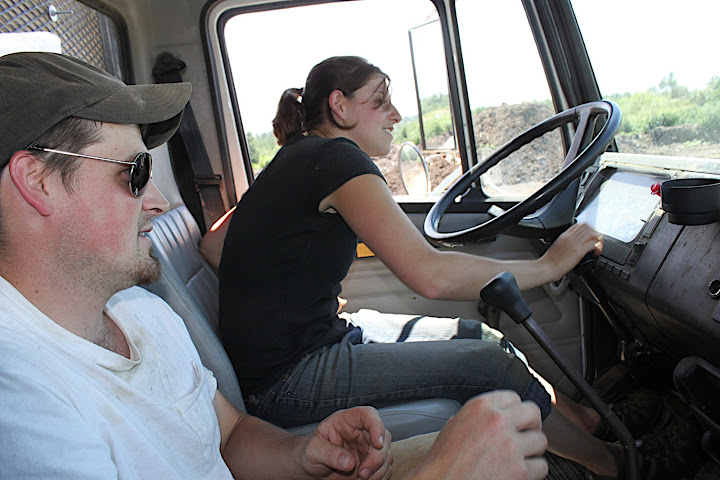
I look like I know what I'm doing, right? Ryan is not so sure.
The adventures were prompted by the previous week's revelation that Claire doesn't have her license yet. The guys on Kay-Ben were a bit dumbfounded. After all -- we learned on Tuesday over lunch -- Erica got her first car for her fourteenth birthday. She used to drive it across the fields, and right up to the road, to her babysitting gig.
So, on Tuesday, Eddie came driving up to us in some giant machine or other and asked Ryan what we were up to.
"Right now we're taking out old feed," Ryan said, and went on to list the other things on the roster for the day.
"All right, well I've got a chore for you to do. It's really been bugging me. I want you to take those girls up the hill and teach them to drive that Freightliner and dump the body."
If either of us had known exactly what that meant at the time, we'd probably have been a tad more taken aback.
Eddie added, "There's not an American farm girl who doesn't know how to drive a dump truck," and drove off.
I talked with Ryan on Wednesday about the difference between growing up country and growing up city. I used to take riding lessons; he used to own two horses. I'm proud of my recently acquired stick shift skills; he does almost all of his own auto repair work. I remember his assertion at our first Kay-Ben story circle that a farmer has to be a jack-of-all-trades, and he certainly lives by that.
How do they learn all they know? Trial and error. Sometimes I'm amazed by the amount of knowledge everyone on the farm has amassed about cows alone. They just know things about cow personalities and cow preferences and the ways to keep a cow happy. (Erica, struggling with a recalcitrant milker she's trying to move between pens: "She's got control issues. Some of them won't move unless they feel like they're in charge. If I'm in front of her, she feels nervous because she's not in control, but if I'm behind her like this, she'll go -- and then I just have to figure out how to steer her.")
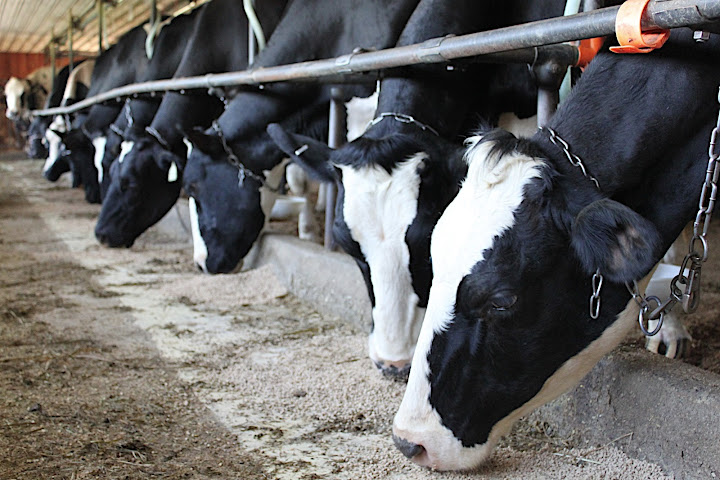
Sometimes, it's their way or the highway.
Knowledge like that can't really be gained any way other than being around the animals constantly for years and years. And the learning is an ongoing process. Eddie told Erica on Tuesday that one of the cows looked like she'd put on a lot of weight. "Something has to be done about that," he said. Erica plans to give soy a try, but if that doesn't do the trick, they'll be on to looking for a different solution. Certainly they give some credit to what "experts" on cattle feed say, but they're also experts themselves, especially when it comes to their own herd. And they are well aware that, often, the experts get it wrong (like when an overly optimistic weather forecast for Thursday led to thousands of dollars worth of hay getting soaked).
As Ryan was sitting between me and Claire on the Freightliner, watching me struggle with the finicky clutch and the barely-differentiable lower gears, he told us how his brother taught him to swim. "He just threw me in the water and said, 'Survive.'" His teaching style for us was a little kinder, but in the end, for me, it wasn't until Eddie insisted that I drive the truck and dump the body alone -- no one else in the cabin -- that I really felt like I'd made progress towards learning, not just to drive it, but to operate it. When I didn't have anyone looking over my shoulder, anyone of whom to ask constant questions, I no longer stalled or struggled with pulling the lever to release the body. I just did what seemed to make sense in the moment, and usually, it turned out to be right.
On a side note: Yesterday I went to Nateva, a big music festival in Oxford, ME. The Felice Brothers may have become one of my new favorite groups, and they sang this gorgeous song that, as they put it, is about farm life and the hardships that can sometimes accompany it. It reminded me of a lot of conversations we've had, in and out of story circles, about the rollercoaster of emotions involved in farming -- and, also, about that romantic view of farming as "the simple life." I think the song takes a romantic view of farming, although it certainly doesn't paint it as easy. At any rate, it affected me a lot and here it is.
Subscribe to:
Posts (Atom)


