Of Farms and Fables combines the efforts of professional and non-professional artists by engaging artists in farm work and farm workers in storytelling and acting. The result will be an original performance in October of 2011 which will engage performers and audience in dialogue about local agriculture, farming, and the future of small family farms in Maine.

Showing posts with label Maine. Show all posts

Friday, October 21, 2011

They're Growing Music! (Seth Asa)

In my teen years, my mother was a writer for The Journal Tribune. I spent afternoons at the newspaper office in Biddeford, browsing promotional CD's by aspiring bands hoping to be reviewed. Later, as a WBLM intern, I made my way through more promotional CD's never destined for 100,000 Watts of Rock N Roll airwaves. I analyzed combinations of appealing band names, cover artwork, and song titles, and chose my auditions accordingly. Using this system, I found some of my most enduring favorites.

Part of my duty as Sound Designer for Of Farms and Fables is to help choose music for the show.

I began on the information superhighway, cruising for Maine bands and songs about farming. With blazing fast speed, I was directed to www.reverbnation.com/dogwantsoutband and the music of Dog Wants Out. Loved the name. Loved the artwork. Loved the song titles. As I listened to Moo for Me, Who's Your Farmer? and Pickle You, I felt I had discovered a musical voice for the show. Upon visiting www.dogwantsout.org, I learned of our shared goal for the promotion of local agriculture, farms, and farmers.

Jennie and I struck up a dialogue with John Zavodny of Dog Wants Out regarding our desire to use DWO's music for Of Farms and Fables. Not only was John open to the idea, he provided several additional as-yet-unpublished recordings for our use!

It is a rare blessing, when searching through band names, artwork, and song titles, to discover real people and to make new relationships. We are fortunate to have been given access to advance recordings intended for the forthcoming Dog Wants Out album, "The Farm Market Waltz."

To hear an audio piece featuring clips from "The Farm Market Waltz" with excerpts from a phone interview with John Zavodny of Dog Wants Out, simply follow the link below or use the "Production Audio" widget in the column on the right-hand side of the page.


http://soundcloud.com/sethasa/john-zavodny-on-dog-wants-out


Dog Wants Out plays "Alternative Funtry Music" with a folk sensibility. Their set list is designed to provide hum-along opportunities for the farmer's market crowd and includes "He Thinks my Tractor's Sexy," "Who's Your Farmer?" "Melt with You," and "Harvest Moon."

Dog Wants Out is Amy Arnett on Fiddle, Anna McGalliard on banjo and washboard, Chris Marshall on bass, Sara Trunzo singing and playing the mandolin, Cody Zane on suitcase trapset, and John Zavodny on guitar and vocal.

WERU Community Radio is the Media Partner for the Dog Wants Out Farmer's Market Tour (www.weru.org).

Dog Wants Out is an initiative of the Maine Community Music Project, a Unity Barn Raiser's Program (www.unitybarnraisers.org).

To learn more about Dog Wants Out, please visit:

Thursday, September 29, 2011

The Sounds of "Silence" (Seth Asa)

I have recently returned to the backwoods of Maine after fifteen years of living in cities, eleven of which were spent in near-desert conditions.  There is a profound difference in baseline silence here, free from the sonic weight of jackhammers, sirens, and constant traffic.  As I made my way into New England, at the end of the long drive from the Pacific Northwest, I had only to roll down my window and I could hear life in the trees that lined the highway.  There is no true silence here (or anywhere on Earth) but in the backwoods, microcosmic worlds provide a subdued, yet rich, aural landscape.

Here in Maine, all senses are engaged.  The autumn air smells crisp, the handle of the chopping maul feels cold in the hands, the stars in the sky are a tapestry of light, the harvest tastes ripe, and among the crickets and autumn birds the rustle of browned leaves landing upon their kin signals the turn of seasons.

The audio widget at the top of the page will allow you to hear some of the nature recordings I have been making for "Of Farms and Fables."  These online sounds are best enjoyed with headphones... especially the clip of leaves falling, a gentle sound almost as quiet as the moon.

I will continue to update the playlist as I collect new audio.  Happy listening!

Saturday, August 13, 2011

Theatrical Sound: Natural Noises (Seth Asa)

 Hello, Of Farms and Fables fans!  I'm Seth Asa Sengel, the Sound Designer for this fabulous project.

Sound Design begins with observation.  During each day of our lives we are surrounded by multiple layers of sound and part of being a sound designer is learning to deconstruct the sonic sum to hear its multiple parts.

Even in the quietest spaces there is sound.  It has been said that in a perfectly silent room, one may even hear the sound of their own nervous system!

The key to theatrical sound is not, as one might think, to directly and accurately reproduce the natural sound of an environment, but rather to work within the aural landscape to capture the natural feel of an environment while leaving sonic space to allow the actors to deliver the story.

Farms are rich with layers of sound.  Animals, machines, ambient insects, and the movement of the surrounding flora, all contribute to the sound of a farm.  For this project, in order to best represent the sonic ecosystem of farm life, I will begin by capturing live audio recordings of our partnering farms, both for reference and for source material for the design.

I will endeavor in future posts to include audio samples, if I can.  More to come...!

Sunday, July 24, 2011

Being There (Cory)

At the farmer reading of the first draft of our script, back in April, this screenshot captures what my view was like:


I was in the room on Skype, and so I got to see some of the faces (depending on what portion of the circle I was aimed at), and hear the voices (sometimes missing words here and there), and even get some live feedback (though to respond, I had to shout).

At the second farmer reading, on a toasty July evening, the view from where I was sitting was a little fuller:


The difference is really profound. Feedback can be written down and emailed, interviews can be recorded and uploaded, but the energy that's there when you're all in the same room, breathing the same air, eating slices of the same pizza - there's not yet an app that can bottle that. When it comes to a play reading, spoken feedback is really important but so is that feedback that can't be thought out or planned: spontaneous reactions to a line or a scene that happen in the moment, that come from the gut, that are expressed not in words but in a sigh or a shift of the body or a chuckle or a glance. Being back in Maine after 11 months of working long-distance was a powerful reminder of the importance of the little things.

When I started writing the first draft, I felt like I was taking a jump into the dark. Working on the second draft was even scarier: for a long time, it seemed like I was writing a completely new play, and I felt there was no guarantee that it would constitute a step forward. The energy of support in the room during our reading last week, and excitement about the new draft, was something I was thankful to be in the room to feel.

I wanted to share some cool resources I found this week:
  1. Transferring the Family Farm: What Worked, What Didn't for 10 New Jersey Families - This document, available on the NESFI website here, gives 10 fascinating case studies of New Jersey farms transferring their property and business from one generation to the next. Working through them is really helping to give me a better understanding of the issues, tensions, and concerns involved in farm transfer, which has become a central concern of our script. Biggest lesson: Farm transfer is a REALLY involved process. It takes years - sometimes decades - to do it right.
  2. DACUM Occupational Profile for Northeast Small Scale "Sustainable" Farmers - Also found on the NESFI site; this is a profile, developed through farmer focus groups, of the skills and duties it takes to be a "small scale sustainable farmer," but they're definitely widely applicable, for the most part, to all types of farmers.

Friday, July 30, 2010

The Trauma of Summer (Cory)

Reading Lew Dietz's Night Train at Wiscassett Station (subtitled, self-explanatorily, "An Unforgettable Portrait of Maine and Its People"), I come across a section on the seasons. Under "Summer":
For those who call Maine home, summer has become a season of alloyed pleasure, a time of waiting for its end ... As abrupt as a slamming door, Labor Day brings to a close this season of mixed blessings ... By the time of October's hunter's moon, the trauma of summer has been healed, health and sanity restored.
I can't imagine Jordan's or Broadturn without summer. Heat and horseflies, fickle summer rain, plants perked up in the still-cool mornings only to be wilting and sweating by July noon. High school and college students on summer vacation working the fields (let's not forget, as someone brought up in a recent story circle, that the frenzy of summer farm activity is the reason why American summer vacation is the four-month monster that it is). Summer defines the vegetable farm for me, and it is strange to think of it as an anomaly, a "trauma." Does Dietz's assessment of Mainer sentiment towards summer apply to Maine farmers?

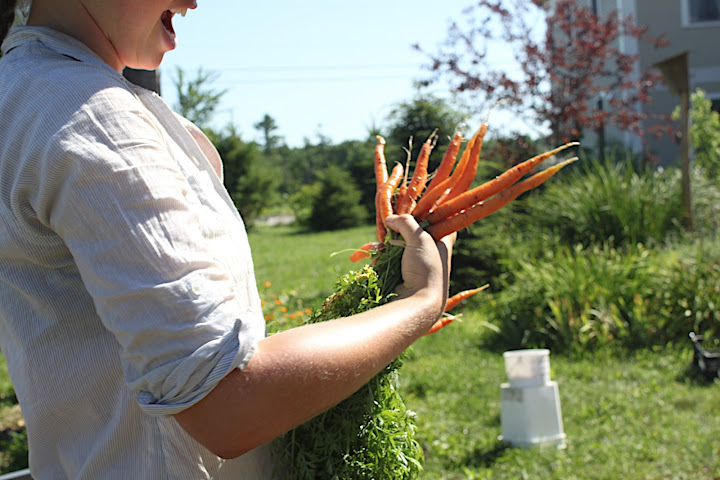
Broadturn this week was a frenzy of growth and color. On Tuesday, from the orange shock of carrots...


...to the deep purple pleasure of these little onions...


...it was the most diverse and colorful CSA harvest day I'd seen to date.

We picked lemon cucumbers (they look like little golden apples) and more traditional cukes, three varieties of squash (zucchini, summer, and patty pan), cabbage, lettuce, basil, parsley, and kale. And flowers. Buckets and buckets of flowers.

And we dug for new potatoes -- I found a heart-shaped one.

There are all sorts of new faces on the farm since I was last there: the little turkeys and chicks that peck at Flora's worm fingers through their wire cage until she squeals with delight, the solemn gray geese weeding the strawberry field and escaping past the electrified fence for 5am goose joyrides; sunflowers now grown tall as athletes, tomato plants jungling up the hoop houses until they're practically clamoring out the door...It's like the farm is in a fever and this bounty is its delirious dreaming.

There's no question that it is thrilling and rewarding to see the farm exploding with the fruit of all we've helped to plant and nurture the past two months. But as the pace accelerates to what I've got to label breakneck, I can see how unsustainable that pace is, how impossible it would be to live a summer of this sort year-round. Carrot-induced excitement and pride is mixed with sweaty exhaustion on everyone's faces. The frequency with which we forego "tensies" on harvest days is sobering. This isn't ordinary; this is crunch time.

Looking over the coming month's calendar with the interns, Stacy reminds them they won't be working Saturdays anymore in August. And I am reminded of Trae's assertion that July is always crazy time at Jordan's. And I am privy to farmer daydreams of farmer shortcuts, born of quiet longing after slightly more leisurely days ("If I had a superpower, I'd be...Carboneto," says John. "Like Magneto, from X-Men, only I would be able to attract whatever weed or plant or like, carbon-based object I wanted to at the time"). And I think about what summer really is: the Earth in heat. The Earth in all her fertility and fecundity, a mammoth lover demanding satisfaction, building to her colorful July climax, her explosion of flavors and treasures that can't be postponed or denied.

We need summer to get through the winter. We need summer to produce fruits and vegetables to store up for times when fruits and vegetables won't grow. (I find myself feeling more and more aware of the meaning and purpose of food preparation. "We pickle things to make them taste good," a friend said to me last week. "No, we pickle things to preserve them," I retorted, taken aback by how strongly I felt.)

But summer is...overwhelming. A race to make the absolute most of the Earth's sweaty embrace before she retreats, satisfied, to a chillier season. Stacy and John speak wistfully of winter and I can sense, though I haven't lived it on a farm, the reasons for relief at summer's passing. Summer is something you prepare for and recover from, but, like an orgasm or a fever dream, while it's happening you have to just survive it.